
In many commercial and industrial buildings, comfort complaints are not caused by a lack of heating capacity. They are caused by where the heat actually ends up. Anyone who has worked in a warehouse in January has seen it happen: the heaters are running, the roof deck is nice and warm, and the people on the floor are still wearing jackets.
When most people think about heating a building, they picture warm air blowing from a furnace, rooftop unit, or unit heater. Infrared radiant heating works differently. Rather than relying on air as the primary means of moving heat through a space, radiant heaters transfer energy directly to people, floors, equipment, and surfaces below.
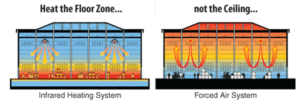
The goal is not just producing heat. It is delivering it to the occupied space.
A familiar example is the sun. On a cool spring day, you can still feel warm standing in direct sunlight, even if the air around you is chilly. That warmth is radiant energy. It travels in waves, reaches your skin or clothing, and is absorbed as heat. Infrared radiant heating uses the same basic principle inside a building.
Infrared energy is part of the electromagnetic spectrum. It does not need air to carry it from one place to another, which is why it can be so effective in large, open, or high-ceiling spaces. When infrared energy reaches a surface, it is absorbed and converted to heat. In a building, this means the floor, machinery, tools, vehicles, and people in the heater’s path are warmed first. Those warmed surfaces then help release heat back into the surrounding area, creating comfort where it is needed most.
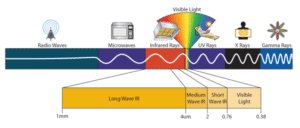
Infrared energy is part of the electromagnetic spectrum and transfers heat directly to surfaces and occupants.
This is a key difference between radiant heating and traditional forced-air heating. Forced-air systems consume a lot of energy trying to heat the entire air volume of a building. In a facility with 30-foot ceilings, that is a lot of air to keep comfortable, especially when half of it is hanging out near the ceiling trusses while employees, workstations, and floors remain cooler below.
Infrared radiant systems direct heat down toward the occupied area. Instead of trying to heat the entire volume of air from floor to ceiling, they focus energy on the surfaces and people within the space. This can help reduce issues related to heat stratification and make the lower levels of a building feel more comfortable. Infrared radiant heat tends to make sense very quickly once you experience it. Stand beneath a properly designed radiant system in the middle of winter, and the concept becomes a lot less theoretical.
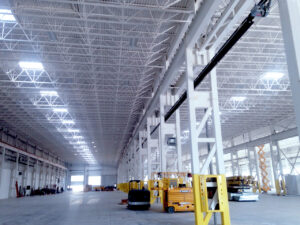
In large industrial spaces, where the heat goes matters just as much as how much heat is produced.
Gas-fired infrared radiant tube heaters operate by burning natural gas or propane inside a heat exchanger tube. As the tube heats up, it emits infrared energy. A reflector above the tube helps direct that energy downward toward the floor and occupied area. This makes radiant tube heaters a strong fit for warehouses, manufacturing facilities, loading docks, vehicle service areas, agricultural buildings, and many other commercial and industrial applications.
Radiant heat is also useful in buildings where doors open frequently or where drafts are common. With forced-air heating, opening a large overhead door can allow a significant amount of warm air to escape. With radiant heat, surrounding floors, equipment, and other surfaces retain warmth, helping the area recover faster after doors are opened and closed.
Another benefit is zoning, or spot heating. Radiant heaters can be positioned to serve specific work areas, production lines, service bays, or storage zones. That means a building does not always need to be heated the same way from wall to wall, especially when certain areas are used more often than others.
At its core, infrared radiant heating is simple: energy travels from the heater to nearby surfaces, which absorb it, and warmth is delivered where people actually feel it. By focusing on people and objects rather than large volumes of air, infrared radiant heating offers a practical, efficient, and comfortable solution for many commercial and industrial spaces.