

In Part 1 of our reflector series, we looked at why terms like “100% efficient,” “single-pass,” and “dual-pass” do not, by themselves, establish how an infrared heater performs.
That raises the next question: If geometry alone cannot establish performance, how is radiant output actually measured?
For gas-fired infrared heaters, the answer starts with understanding the difference between standards that address safe construction and operation and those intended to measure radiant performance.
Safety Certification vs. Performance Rating
Gas-fired infrared heaters sold in North America are evaluated to applicable ANSI/CSA appliance standards. High-intensity heaters are covered by ANSI Z83.19/CSA 2.35, while low-intensity radiant tube heaters are covered by ANSI Z83.20/CSA 2.34.
These standards address construction, safe operation, combustion, temperatures, controls, venting, and other safety-related requirements.
CAN/ANSI/AHRI Standard 1330-2024, Performance Rating for Radiant Output of Gas-Fired Infrared Heaters, serves a different purpose. It establishes a standardized method for testing and rating radiant output. Use of the AHRI performance-rating method is voluntary.
AHRI 1330 evaluates the heater’s radiant output rather than assigning a separate performance rating to the reflector, emitter tube, burner, or another individual component.
Safety certification addresses whether a heater meets applicable requirements for safe construction and operation. AHRI 1330 addresses how its radiant output is measured and rated.
Why Does a Standardized Test Matter?
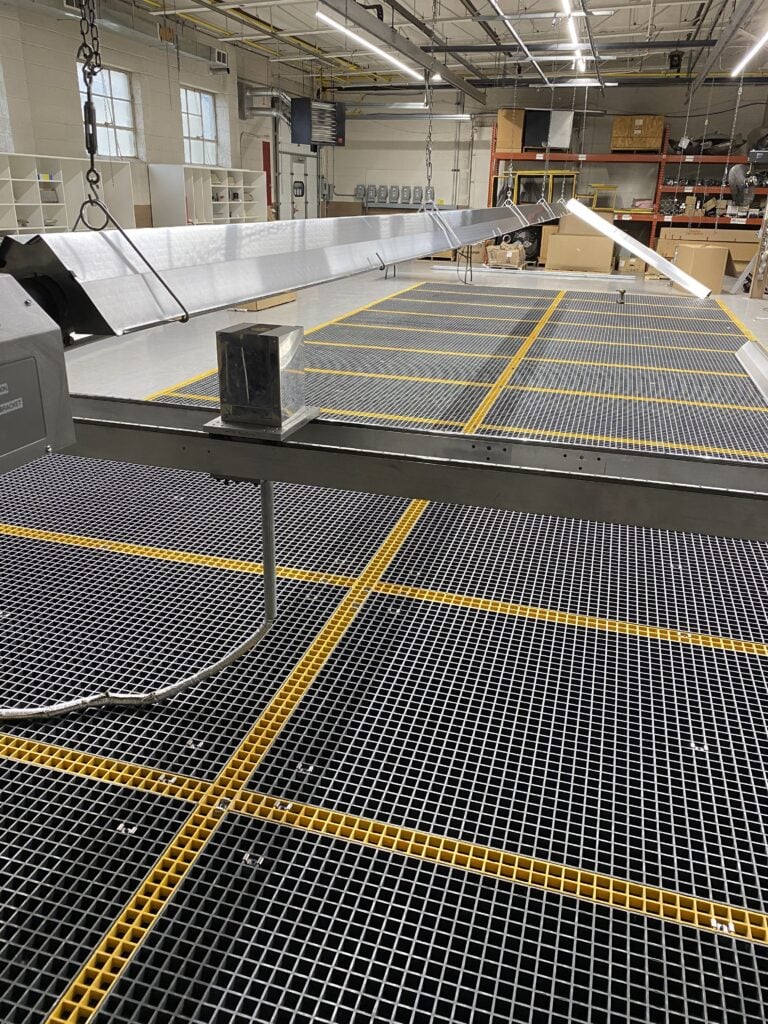
Radiant-output testing evaluates the complete heater under controlled conditions.
Radiant output is not as simple as measuring the temperature of the emitter tube or taking one reading directly beneath the hottest part of the heater.
A tube heater produces radiant energy across its entire length and over an area below and around it. Output also changes along the tube, with higher temperatures generally occurring closer to the burner and lower temperatures farther downstream.
A single measurement can tell you what is happening at one location. It does not tell you how the heater distributes radiant energy throughout its overall coverage area.
A standardized test method provides a consistent way to collect multiple measurements under defined conditions. When different heaters are evaluated using the same methodology, the resulting data provides a much more meaningful basis for comparison.
What About Stack Temperature?
Stack, or flue-gas, temperature is another measurement that can be misunderstood when comparing infrared heaters.
For low-intensity tube heaters in North America, ANSI Z83.20/CSA 2.34 includes limits on flue-gas temperature as part of the safety evaluation. For certain vented configurations, flue-gas temperature is limited to no more than 480°F above room temperature.
That is a safety criterion, not a radiant-performance rating. A lower stack temperature by itself does not establish that one heater delivers more radiant energy than another.
European performance requirements treat flue losses differently. For tube heaters, energy lost through the flue can factor into useful-efficiency calculations while radiant performance is evaluated separately.
In other words, a stack-temperature limit and a radiant-output rating answer different questions.
How Is Radiant Output Mapped?
Radiant testing takes measurements at multiple defined locations within a measuring plane beneath the heater. Those readings show how radiant energy is distributed across the heater’s coverage area.
The resulting radiant map provides something a single peak value cannot: a picture of where the energy is actually going.
Two heaters may produce similar output at one location while creating very different radiant patterns overall. One may concentrate more energy near the burner while another maintains stronger output farther downstream.
That distribution matters when designing a system for an actual building.
What Is Radiant Emission Value?
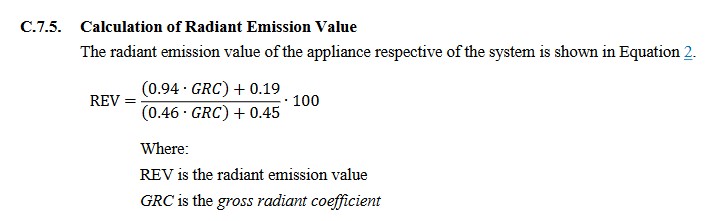
Radiant Emission Value (REV) is calculated from the Gross Radiant Coefficient (GRC) using the relationship defined in CAN/ANSI/AHRI Standard 1330-2024. Source: CAN/ANSI/AHRI Standard 1330-2024, Section C.7.5. © Air-Conditioning, Heating, and Refrigeration Institute (AHRI).
The measured data is used to determine the heater’s radiant performance. One term used in this process is Radiant Emission Value, or REV.
REV replaced the older Infrared Factor, or IF, terminology. It is derived from the heater’s Gross Radiant Coefficient, or GRC, using the calculation prescribed by the standard.
In practical terms, REV provides a standardized way to characterize radiant emission based on measured test data. It gives engineers, manufacturers, and specifiers a common basis for discussing radiant performance under the conditions defined by the standard.
The important point is not simply the acronym. REV is based on measured heater performance, not on an assumption about what a particular reflector shape, material, or other individual component should theoretically do.
How Does Detroit Radiant Products Test Infrared Heaters?
Detroit Radiant Products operates an accredited on-site laboratory with equipment capable of radiant-output testing.
Our automated radiant test rig collects measurements throughout the test area and compiles the data for analysis. The results can be used to calculate radiant performance and create output maps showing how energy is distributed along and across the heater.
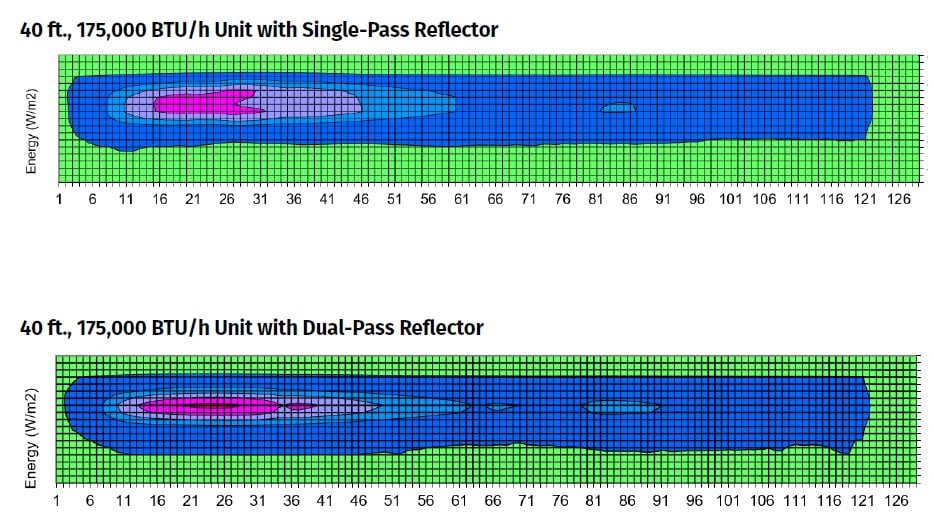
Radiant output maps from controlled laboratory testing show how different tested configurations distribute radiant energy across the measurement area.
Controlled testing also makes it possible to change one design variable while keeping others consistent. For example, two reflector configurations can be tested using the same heater length and input under equivalent conditions.
That provides measured evidence of how a design change actually affected radiant output rather than relying on a drawing to predict the result.
What Should You Look for When Comparing Infrared Heaters?
Start by making sure you are comparing like with like.
Published radiant-output data is most useful when heaters are evaluated using the same recognized test method and comparable rating conditions.
It is equally important to understand what a particular number actually represents. Safety certification, stack-temperature limits, and radiant-output ratings serve different purposes and should not be treated as interchangeable measures of performance.
And laboratory data is still only part of system design. Mounting height, heater spacing, controls, building geometry, obstructions, ventilation, and occupancy all affect how a heater performs once installed.
If reflector geometry tells us how a heater is intended to behave, testing tells us what the heater actually delivers.
In Part 3, we’ll look at how reflector material, geometry, emitter temperature, and other design choices interact — and why those differences can show up in measured radiant performance.