
When evaluating heating options for a commercial or industrial building, infrared radiant and forced-air systems are often compared as though they accomplish the same task in roughly the same way. They do not.
Both systems can create a comfortable indoor environment, but they deliver heat differently. Forced-air equipment heats and circulates air throughout a space. Infrared radiant systems direct energy toward people, floors, equipment, and other surfaces within the heater’s coverage area.
That distinction can have a significant effect on comfort and performance, particularly in buildings with high ceilings, large overhead doors, frequent air changes, or areas that are not occupied equally.
How Forced-Air Heating Works
Forced Air Heat
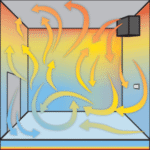
Forced-air systems use a furnace, rooftop unit, or suspended unit heater to warm the air. A fan or blower then moves that heated air through ductwork or directly into the building. This approach is familiar, widely available, and well suited to many applications. Forced-air systems can provide broad temperature control and may combine heating with cooling, ventilation, filtration, or humidity management. In enclosed buildings with relatively low ceilings and evenly occupied spaces, that versatility can make forced air a practical choice.
The challenge is that warm air is buoyant. In a building with tall ceilings, heated air can rise and collect near the roof while the people and work areas below remain cooler. This temperature layering, commonly known as stratification, may also increase heat loss through the roof. Fans can help distribute the air, but they can also create drafts, noise, and localized hot or cold areas. When a large overhead door opens, a portion of the conditioned air may leave the building and be replaced by colder outdoor air that must then be reheated.
How Infrared Radiant Heating Works
Radiant Heat
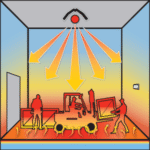
We’ve covered how infrared heating works in a previous blog, but here’s a quick recap. Infrared radiant heating takes a different approach. Instead of first heating and circulating the entire volume of air, the heater emits infrared energy toward the occupied area. People and surfaces absorb that energy and convert it into heat. Warmed floors, machinery, and other objects then release some of that heat into the surrounding environment.
Because air is not the primary means of transferring radiant energy from the heater to the occupied zone, infrared systems can be particularly effective in large, open, or high-ceiling buildings. They can also support zoned or spot-heating strategies in which only selected work areas require heating. Radiant heaters still contribute to warming the air, and they do not eliminate building heat loss. Their advantage is that they can direct a larger share of the available heat toward the people and surfaces that need it rather than depending entirely on warm air remaining in place.
Why Ceiling Height Matters
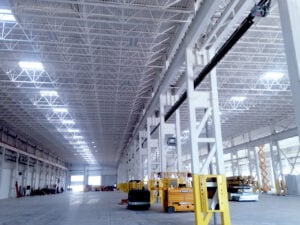
Low intensity radiant tube heaters used in a manufacturing facility.
In an office with an eight- or ten-foot ceiling, the difference between floor level and roof level may be relatively modest. In a warehouse, manufacturing facility, aircraft hangar, or vehicle service building with ceilings of 20, 30, or 40 feet, it becomes a much bigger part of the heating conversation.
An ASHRAE Journal review noted that infrared radiant heaters can deliver heat more effectively to occupants in high-ceiling commercial and industrial spaces. The article also made an important distinction: radiant heaters do not necessarily transfer more heat into the building overall than unit heaters. Instead, they can direct that heat more effectively toward the occupied zone.
That difference helps explain why a building can have ample installed heating capacity and still receive comfort complaints. The heat is being produced; it may simply not be ending up where people are working.
What Happens When Large Doors Open?
Buildings with loading docks, service bays, vehicle entrances, or aircraft doors present another challenge. When those doors open, heated air can escape quickly. Radiant heating is not immune to that heat loss, but it does not rely solely on maintaining a large volume of warm air. People and surfaces within the heater’s coverage area continue receiving radiant energy while the system is operating, and previously warmed floors and objects retain some heat after colder air enters the space.
This can make radiant heating a strong option for garages, loading areas, maintenance facilities, and other buildings where door cycling is part of normal operation.
What Do Comparative Studies Show?
Energy savings depend on the building, insulation, controls, operating schedule, outdoor conditions, system design, and many other factors. No single comparison can promise one universal percentage.
However, comparative testing has shown meaningful savings in certain applications. A three-year study conducted in a commercial facility with frequent overhead door openings compared a forced-air unit heater with a two stage infrared tube heating system. Some test periods documented infrared savings of 19.5% and 23%, while an earlier test showed minimal savings. The study also identified the warmed floor slab—described as a thermal flywheel—as an important contributor to performance.
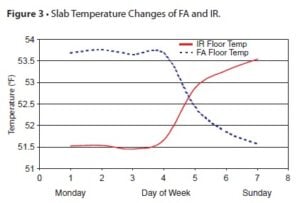
ASHRAE Study Slab Temperatures
That range of results reinforces a practical point: equipment type alone does not determine energy use; the building and the way each system is designed and operated matter just as much.
Which System Is the Better Choice?
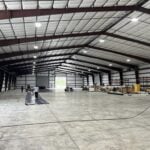
FA Series unit heaters used in a warehouse
Forced air may be the better fit when a building needs one integrated system for heating, cooling, ventilation, filtration, or highly uniform air-temperature control. It may also make sense in offices, smaller enclosed spaces, and buildings where suitable radiant mounting locations or required clearances are unavailable.
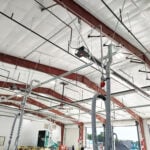
Infrared radiant tube heaters used in a vehicle repair facility
Infrared radiant heat may offer important advantages in high-bay buildings, draft-prone facilities, areas with frequent door activity, or applications that benefit from zoned and targeted comfort. Radiant systems do not require extensive ductwork to distribute heat, but heater placement, mounting height, clearances, controls, and obstructions must all be considered carefully.
The choice is not always either/or. Some buildings use forced-air systems for ventilation, cooling, or general air-temperature control, while using radiant heat in work zones, perimeter areas, loading docks, or other spaces with specific comfort challenges.
Radiant and forced-air systems are not interchangeable, but they can be complementary. Each responds differently to ceiling height, air movement, occupancy, door activity, and zoning requirements. The best heating strategy starts with understanding how the building is used and then choosing the system—or combination of systems—that delivers comfort where it is actually needed.